
University of California, Los Angeles, Athletics
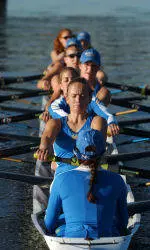
Photo by: UCLA Athletics
Ask The Bruins - Women's Rowing
April 17, 2006 | Bruin Athletics
|
||
 |
||
| Bruin Fan: Jessica Fritz, I saw in the past you have been a very strong rower, but were recently moved to the 2nd Varsity 8 boat. Are you still determined to work just as hard? And are you striving to get back into your old boat? If so how do you plan to? | ||
| Jessica Fritz: I continue to be a strong rower. In fact, my performance this year has been one I am very proud of. My determination to work as hard as I possibly can does not depend on what boat I am seated in. I always give my utmost effort as a member of the UCLA Women's Crew team. My goals are personal as well as shared with the team - and going to the NCAA National Championship remains a goal for the whole team. I strive to do the best I can in personal training, as well as in making whatever boat I am in move as fast as possible down the race course to the finish line. Go Bruins - Row To Win! | ||
| Kelly (San Diego): This question is for Coach Fuller Kearney. As an unexperienced rower, is it possible to join the team as a novice? What advice would you give to aspiring Bruin rowers? | ||
| Amy Fuller Kearney: We encourage athletes who have never previously rowed to come out and give it a try. In fact, I did not start rowing until my sophomore year in college. To be successful, you need to be very competitive and have a good fitness level. You must also want to push yourself mentally and physically and be a great teammate. Look for us on Bruin Walk during the first week of school if you are interested. | ||
| Stephanie (Newport Beach): Question for Sarah Lombardo. As a former varsity soccer player at UCLA, what was the biggest change in switching to the rowing team? | ||
| Sarah Lombardo: Getting up early and wearing all that spandex. I'm only kind of kidding. I'd also have to say the early hours are quite a change. I wasn't quite used to seeing 5:30 on my alarm clock! It's interesting how the team has such a diverse group of people in terms of their levels of rowing experience. On the soccer team, almost everyone had been playing since they were 5 years old and came from highly competitive club teams. Some of the best rowers didn't start until college. For the most part, though, there are quite a few similarities, as I suppose there are with most college-level teams. | ||
| Michelle, Los Angeles: Hi! I am wondering what the the fastest 500 M time is that any of you have pulled on the rowing machine? Thanks | ||
| Erin Rice: The fasted 500m time on the erg is a 1:36.1. That was pulled by Monica Grova, who graduated last year. | ||
| Lee (Ventura): What is it like to be a freshman in the stroke seat of a varsity boat? | ||
| Vanessa Teff: Being a freshman has not made stroking more difficult. The stroke seat, in and of itself, is difficult. Stroking is accompanied by pressure and responsibility, and it also requires much focus. However, the support and confidence I receive from my coaches and teammates has enabled me to rise to the challenge. | ||
| Lee (Ventura): Sarah...as a senior, will you miss rowing? | ||
| Sarah Lombardo: It will be nice to get enough sleep again, but I will certainly miss the time spent with my teammates on the water. It is a very satisfying feeling to get in a hard workout before most people have even left their beds. I hope I can continue to row recreationally after I leave UCLA. | ||
| Lee (Ventura): Vanessa...how do you like living in LA? How does it compare to your hometown in Wisconsin? | ||
| Vanessa Teff: I love living in L.A. The only thing I'm still not used to is the traffic! Back home, we give directions based on how long it takes to get to the desired destination. Here, everyone speaks in terms of mileage. I've quickly become acclimated to the laid-back lifestyle and find myself fitting in quite nicely. However, the one item I'm struggling to live without is real Wisconsin award-winning cheese! | ||
| Lauren Rice, St Louis: How does seat racing work? What information does it give the coaches? | ||
| Amy Fuller Kearney: Seat racing is just one of many tools used to help boat selection. We also consider erg score, daily performance, team dynamic, performance under pressure, consistency and many other things. In seat racing, two boats line up and race a specified distance. Times are taken, and at the end of each piece, rowers are switched between the boats. The teams line up again and race the same distance. Again, times are taken, and any margin differences/time fluctuations are noted. The problem with seat racing is that many times results between two shells vary without any athletes switching. It is almost impossible to remove all the variables besides the two athletes being switched. Therefore, we primarily use seat racing to test combinations and see how athletes perform in the face of personal accountability. | ||
| Prospective Rower, CA: Does balancing crew, school, and other social activities ever become too overwhelming? | ||
| Vanessa Teff: Balancing academics, athletics and extra-curricular activities can indeed be overwhelming. However, it is not impossible. Being a student-athlete has taught me to manage my time and not procrastinate. | ||
| Sarah Lombardo: It can be a little hard, especially during midterms and finals. My teammates and I often make trips to Starbucks for a caffeine boost to help keep us alert while studying. However, having more things to do in a day has made me more productive. Learning to budget your time and prioritize is essential. It does get stressful at times, but it always works out. Socializing can be a little tricky because of our hours (most of us go to bed around 10 pm), but we are a pretty close team, and the majority of our social activities are with teammates or other athletes. | ||
| Erin Rice: When you are a student-athelete, your life does become hectic at times. However, if you manage your time well, it is a wonderful experience. I love being part of this team, and even though it can be stressful and I feel overwhelmed sometimes, I've found that it is a positive influence over how I carry myself. The trick is to make sure you fit in time for yourself to take a break from the routine. For example, when I need some down time, I like to go watch UCLA volleyball and basketball games with my friends or go down to westwood to catch a movie. | ||
| Kellie (San Clemente): Coach, in terms of walk-ons, do you look more for good overall athletes or for people who have any kind of rowing experience? | ||
| Amy Fuller Kearney: In terms of walk-ons, we are primarily looking for competitive athletes. You can come from any background, but you have an advantage if you are tall because of leverage and stroke length. You must have a great work ethic and understand that rowing is a sport of speed and endurance. A typical race is anywhere from 6:30 to 7:30, depending on the boat class. This is an all-out effort that requires mental and physical tenacity. | ||
| Lisa (LA): Is it possible to have a tall coxswain, and what are the advantages/disadvantages in regards to height at that position? | ||
| Amy Fuller Kearney: Height of a coxswain is irrelevant, except for how it affects her weight. A coxswain must weigh a minimum of 110 pounds. If a coxswain weighs less than 110, she must carry weight at most regattas. Obviously, weighing much over 110 would be a disadvantage because the rowers would be carrying more weight than they need to down the course. Generally, we look for great leaders who are very competitive and can motivate their squad, and weigh between 110-115. | ||
| Shara (Niantic): Erin Rice, what do you enjoy most about rowing? | ||
| Erin Rice: I always feel an incredible sense of accomplishment when I look back at what I had done on a particular day, a week, and the whole year. My teammates have become some of my best friends, and I love to wake up every morning knowing that we are working to achieve the same goal through all of the ups and downs of the sport. | ||
| Joy (Los Angeles): Coach Fuller Kearney, what intrigues you about rowing? Have you always wanted to coach? | ||
| Amy Fuller Kearney: I fell in love with rowing the first time I sat in a boat. Now, that is not to say that I always enjoyed ALL the hard work, because quite frankly, it is HARD work. But it is safe to say I have always enjoyed the feeling of a boat that is running well. I also enjoyed the challenges and triumphs I experienced in my years as a competitive rower. There is nothing like the feeling of standing on the Olympic podium, but perhaps more memorable are the life-long friendships that develop as you work with your teammates towards a common goal. Sometimes you just don't feel like you can make it through, and then when you do, it is exhilarating. And you are just that much better for it. I can't say I always wanted to coach, but I was seriously considering a career in teaching before I started my rowing career. It wasn't until I took my first coaching job at UCSB that I knew this would become my passion. | ||
| Sarah (Orinda): Coach Amy- How are you preparing the team for the USC meet and how do you feel about the meet? | ||
| Amy Fuller Kearney: We are very excited for the race against USC this weekend. Our focus continues to be on the Pac-10 Championship and getting a bid to the NCAA's, but it is great to have this rivalry and great competitor in our own backyard. They are currently third in the country, and we are 15th, so I think it is safe to say that we are fired up as the underdogs. | ||
| John--St. Louis: Coach Fuller Kearney, How would you rank the catch,the drive, and the finish in order of importance as it pertains to amateur master rowers? | ||
| Amy Fuller Kearney: I think the order of importance is the order which you stated in your question. Of course, all elements of the stroke are important. Obviously, it is the drive that actually propels the boat. However, an effective drive is directly related to a quick, light, direct catch. This allows early power application and good use of the legs. If you miss the catch, you cut down the effectiveness of the biggest muscle group. Once you are in front of the boat speed, it is important to use acceleration to stay in front. What I mean is that if you don't use the back and arms effectively, the boat starts propelling the oar through the water instead of vice versa. In turn, the blade will pop out of the water, and that will be your finish. I could go on, but I hope that helps. | ||
| Prospective rower (CA): Maida, what is your greatest rowing achievement? Also, what are your favorite races and/or venues to race at? | ||
| Maida Habibovic: My greatest rowing achievement was being recruited and accepted by UCLA Rowing. I also consider last year's Windermere Crew Classic as one of my favorite racing moments. That weekend, I was in the freshman eight boat that beat both Cal and Washington. We were very proud and excited to have beaten two fast teams. My favorite race is probably the San Diego Crew Classic because not only are there always good crews to race against, but it's always exciting. It is the biggest regatta we go to as a team, and it is fun to see all the other teams and tents that are selling stuff. Despite the rough weather, San Diego is always a fun race. | ||
| Michelle (TX): Erin Rice, I read in the rowing guide that you are a captain. What does being captain mean to you? | ||
| Erin Rice: It means alot to me that my teammates voted me to be one of the co-captains and that they respect me as someone who is dedicated to this team and who is truly concerned with accomplishing what we are capable of. I have tremendous respect for each of my teammates, and I push myself every day on the water because that is one of the ways I support them. I think some of the most important things I do as a captain is to be strong, encouraging, and understanding of everyone's needs by helping them out when they have a problem, listening when they need to talk, pushing them when they need encouragement, and being happy for them when they succeed. | ||
| McQuown (San Diego): We hear about a good start or a bad start in a race. Are there different ways of starting? If so, on what does it depend? What factors determine a rower's place in the team and in the boat besides the erg? | ||
| Amy Fuller Kearney: There are many different ways of starting, but the Bruins always have a good start! Sometimes nerves can really affect execution, and usually that is when a start would be referred to as "bad". Water is flying everywhere, the boat doesn't go straight, timing is off ... it can be pretty ugly. It is important to stay relaxed and focused. What determines a rower's place in the team and in the boat? Simple - the fastest rowers go in the top 8. The second fastest in the next 8. etc. Perhaps you are asking how the coaches know who is the fastest. Well, it is not always easy, however, there are many tools we use to decide line-ups. Some are objective (erg score, boat performance, pair racing), and some are subjective (mental toughness, attitude, team dynamic). It is not easy. These women are measured, in some capacity, every day. Those who are the most consistent, day in and day out, usually make one of the Varsity boats (V8, 2V8, and V4). |
||
| Amanda (Buenos Aires): ERIN RICE - Is it difficult to balance the time committments of a Division I Varsity rowing team with the academic and social committments of a full-time student at UCLA? Isn't it difficult and stressful? How DO you do it? | ||
| Erin Rice: Sometimes it is challenging to make it all fit together, but I find it manageable for the most part. I always make sure that I make room for down-time so that I can relax and do things for me. I love to go to UCLA volleyball games and basketball games when I get the chance. Being part of this team has only been a good experience for me. | ||
|



Wednesday, June 24
Wednesday, June 17
Friday, June 12
Tuesday, June 09