University of California, Los Angeles, Athletics
Bottom of the Ninth
June 22, 2020 | Bruin Athletics
The following story ran in the Summer 2020 editon of Bruin Blue Magazine. A complete PDF of the article can be accessed HERE.
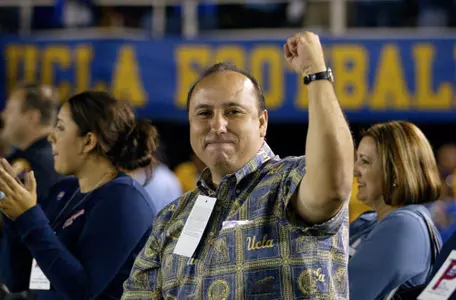
Dan Guerrero may be retiring as the UCLA Alice & Nahum Lainer Family Director of Athletics on July 1, but he will forever remain one of his alma mater's biggest fans.
Case in point: One of his most joyous memories as UCLA's athletic director is when he was in Omaha, Nebraska, watching the Bruins play the Mississippi State Bulldogs in the final game of the 2013 Men's College World Series. Late in the game, with UCLA on the verge of the program's first NCAA Championship, Guerrero assessed the potential post-game situation.
"When the last out was made, and with my heart pumping, I see the mass of humanity on the field — players jumping on each other in sheer elation," Guerrero recalled. "I wanted so badly to be out there with them, but then I realize I'm not 20 years old anymore, and I no longer weigh 185 pounds. If I jump onto that pile, I might not only hurt one of the players, but I might also hurt myself!
"So I turned to [head coach] John [Savage], and we gave each other the biggest hug as tears poured down our cheeks," Guerrero said. "I wound up making the right decision. But for just a moment, I wanted to be 20 years old again."
For his part, Coach Savage was thrilled that his Bruin team was able to deliver the goods for Guerrero. The two men had been colleagues since 2000, when Guerrero — then AD at UC Irvine — hired Savage to revive the Anteaters' dormant baseball program. After Guerrero was hired at UCLA, he tapped Savage to replace head coach Gary Adams, who retired in 2004.
"Working for Dan for almost 20 years now, you have a great deal of respect for the person and the job he has done," Savage said. "We knew how badly Dan wanted to win a national championship in baseball, so when we got it done in 2013, I was so happy for Dan and for all the people who have been associated with UCLA baseball."
Game Stats

an amazing 32 NCAA team championships in 15 different sports,
bringing the school's total to 118. In 2007, UCLA became the
first school in the country to win 100 NCAA team
championships. (PHOTO: Don Liebig/ASUCLA)
That momentous baseball championship was just one of many highlights in Guerrero's 18-year career. When he first took the reins in July 2002, UCLA led the nation with 86 national championships and 108 conference titles. Since then, the Bruins have added 32 NCAA team championships in 15 different sports, bringing the school's total to 118. UCLA also won 73 conference championships in 16 different sports and produced more than 800 All-Americans. In May 2007, UCLA became the first school in history to win 100 NCAA team championships when the women's water polo team defeated Stanford, 5-4. Guerrero has hired seven coaches who have won NCAA titles during his tenure at UCLA.
UCLA's academic accomplishments during Guerrero's tenure have been equally remarkable: The Graduation Success Rate of student-athletes is currently at an all-time high of 90%, while a school-record 64.9% (414 total) earned selection to the Athletic Director's Honor Roll in winter 2020 — quite a feat given the disruption of the last few weeks of the quarter due to the COVID-19 pandemic.
On campus, evidence of Guerrero's fundraising prowess is everywhere. During UCLA's Centennial Campaign (2014–2019), Guerrero and his external development staff raised more than $325 million in fundraising support. The athletics department budget grew from $42 million in 2002 to more than $130 million today, thanks largely to the securing of major long-term contracts with Under Armour and Learfield IMG College. Guerrero also spearheaded the raising of more than $430 million for facilities upgrades, including the renovation of Pauley Pavilion and the building of the Wasserman Football Center and the Mo Ostin Basketball Center.
"As an alumnus and Bruin student-athlete himself, Dan has been dedicated to UCLA, to our fans and to our student-athletes for decades," Chancellor Gene Block said. "Dan has led our teams to numerous victories while emphasizing academic achievement throughout his career. I am so grateful for Dan's unwavering support and service to UCLA."
The Right Time
Retiring from a job he loves was not a decision Guerrero made rashly. He discussed it with his family — his wife, Anne Marie, and his daughters, Jenna and Katie — and also with Chancellor Block. Ultimately, it was two significant changes in his life within the previous 18 months that prompted his decision.

19-year run as UCLA's AD. Left to Right: Guerrero,
daughter Katie, granddaughter Sunny, son-in-law Robbie,
granddaughter Tallulah, daughter Jenna and
wife Anne Marie. (PHOTO: Courtesy the Guerrero Family)
"One was my diagnosis and subsequent successful battle against cancer, thanks to the world-class medical team at UCLA," Guerrero said. "The other was the birth of our second granddaughter last year. Events like these force perspective upon you, and it's incredibly important to me to be able to spend time with our growing family."
Guerrero's retirement will undoubtedly leave a great void in the ranks of the NCAA, especially in the sport of men's basketball. He was a member and former chair of the NCAA Men's Basketball Committee, which is responsible for selecting, seeding and bracketing the NCAA men's basketball tournament. He also served on the Division I Men's Basketball Advisory Committee, which assesses the overall status of the collegiate game, and was chair of the NCAA Men's Basketball Academic Enhancement Group, which has implemented reform measures resulting in higher graduation rates for men's basketball players.
"I feel that Dan's greatest accomplishments have been the work he's done behind the scenes that have earned him the honor of [NACDA] Athletic Director of the Year," said Valorie Kondos Field, the recently retired head coach of the UCLA gymnastics team who was named Pac-12 Gymnastics Coach of the Century. "Those things that none of us really know about, that he certainly doesn't boast about, but have served not only UCLA but all of the programs in the NCAA."
In 2015, NCAA President Mark Emmert appointed Guerrero as the inaugural chair of the NCAA Men's Basketball Oversight Committee, charged with overseeing all elements of collegiate basketball (selection, rules, officiating and competition) and serving as the primary liaison to the NBA, USA Basketball and FIBA (International Basketball).
"Dan's 18-year run as the UCLA AD is admired by everyone working in college sports. For all of us, he has been one of the 'go-to' guys when you want expert advice, great judgment and good values," Emmert said. "His constant focus on his athletes is unquestioned. In every policy debate Dan has been involved in, the bottom line is the same: 'Let's do what's right for the student-athletes.'
"Let's be honest, leading the athletics department of UCLA is a tough task, because it's a place where winning is very important," he added. "Dan has had his share of successes. But if you want to know what Dan really accomplished in these 18 years, look at the alumni who have come through the UCLA Athletics Department and the success they have in life beyond sport. That's Dan's legacy."
Rise of the Warrior
The story of Dan Guerrero's love for UCLA began when he was just a boy. The son of Gene, a refinery foreman, and Esther, a homemaker, Guerrero grew up in blue-collar Wilmington, California. Many of Guerrero's friends and classmates played sports, but those who didn't were often recruited to join gangs. Guerrero's saving grace was baseball; he set his sights on college and an eventual professional baseball career. From age eight, he learned the sport from his father, himself an outstanding athlete with professional aspirations. Those dreams were dashed, however, when Gene lost sight in one eye in an auto accident a year after Guerrero was born. Still, Gene practiced with his son every day.

for UCLA. His coaches, Art Reichle and
Glenn Mickens, nicknamed him "Warrior".
(PHOTO: Courtesy UCLA Athletics)
When it came time to choose a college, there was never any doubt. "It was always UCLA," Guerrero said. "I grew up watching baseball with my dad and listening to him talk about the greatness of Jackie Robinson. I remember him telling me that UCLA was a school 'for the people,' which meant that someone who looked like me — a minority — would be accepted and embraced here."
Guerrero played second base all four years at UCLA. His coaches, Art Reichle and Glenn Mickens, nicknamed him "Warrior" for two reasons: One, because "Guerrero" means "warrior" in Spanish; and two, because they recognized Guerrero's passion, competitiveness, toughness and commitment to winning.
Mike Flores, a former quarterback for UCLA's football team in 1971, was one of Guerrero's best friends on campus. "We were a rare breed, Latino athletes on scholarship," said Flores, who is now president and head coach of Inner Champion Consulting, an executive leadership and coaching firm. "There was an immediate kinship because of our similar heritage, and, as I got to know him better, our similar upbringing. He was from Wilmington, I was from Venice. Both neighborhoods were a diverse composition of ethnicities, which allowed us to form a healthy perspective on getting along with diverse groups."
After graduating from UCLA in 1974 with a B.A. in history, Guerrero's dream was to have a long major league career and wind up in the Hall of Fame. Although that dream never materialized, Guerrero did have a successful career playing professional ball in the Italian Major Leagues. It was there on the beaches of Nettuno, Italy, where he met Anne Marie Aniello, the woman he would marry. "And while I never made it to Cooperstown, I was inducted into the UCLA Baseball Hall of Fame in 1996," Guerrero said. "Therefore, in some respects, I did achieve my dreams."
Coming Full Circle
Prior to and during the off seasons of his professional baseball career, Guerrero worked for L.A. City Council President John S. Gibson Jr. and later co-founded the Harbor Community Development Corporation (HCDC) in his hometown of Wilmington, which provided an array of public services to residents of the Los Angeles Harbor area. He served as its executive director for five years, during which time he earned a master's degree in public administration at California State University, Dominguez Hills.
Following his time at HCDC, he accepted a joint appointment at Dominguez Hills, as a full time lecturer in the School of Management and an unpaid position of associate athletic director in the school's athletic department. Two years later, at age 35, Guerrero was named athletic director at Dominguez Hills. From there, he went to UC Irvine and served as its director of athletics for 10 years (1992-2002), helping to elevate that program to unprecedented success.
When UCLA's longtime AD, Pete Dalis, announced his plans to retire in 2002, Guerrero became a de facto candidate right out of the gate. He applied for and got the job, quickly building an efficient team. In 2004, he hired Petrina Long, who had served as his No. 2 at UC Irvine.
"Dan has great values; he is ethical and very humble in his own way," said Long, who retired as UCLA's senior associate athletic director in July 2016. "He cares deeply about people, about stewardship and servant leadership, and that has been a wonderful environment to work in. ... He's a builder, so there was always another mountain to climb, another sport to add, another facility to build, which always kept my work new and engaging."
His open, friendly style of management is one reason why Alex Olesinski, a senior on the UCLA men's basketball team, chose Guerrero as his mentor for his master's degree program in education.
"He has been very helpful to me, talking about life after UCLA and avenues that I could pursue after athletics," Olesinski said. "We've talked about what kind of business opportunities I might be interested in once I've graduated from college. I feel very honored that our athletic director has always had his door open for me."
Looking Back, Looking Forward
If you ask Guerrero what he thinks is the hardest thing about being an AD, he'll say — hands-down — that it's having to fire a coach. "I have so much respect for the coaching profession, the work required to be successful, the sacrifices that are made and the passion that goes into trying to build winners on and off the field," he said. "But sometimes, for various reasons, it simply doesn't work. After more than 30 years as the steward of a program, this is, without question, the part of the job that I dislike the most."

advice, great judgment and good values," said NCAA President
Mark Emmert.
And for all of those 30 years, Anne Marie Guerrero has witnessed how hard her husband's job can be. "It would be easy for me to say I truly don't know how he does it, how he has handled the incredible pressure and stress over the years. At a place like UCLA, it's a constant," she said. "But in reality, I really do know how he does it. He is simply a man of great faith. If the pressure bothered him, he never showed it to me or our daughters, never brought it home with him. This somehow wound up giving us the peace that we needed, because the criticism can often be so mean-spirited. We know how hard he has worked over the years and, more important, how much he has cared."
And in true warrior fashion, when Guerrero retires on July 1, he won't be sleeping late. He'll assume the role of president of the United States International University Sports Federation, a volunteer position that he will take over from his dear friend and fellow Bruin, Gary Cunningham, who led the group for almost 25 years.
Guerrero's love affair with UCLA, however, will go on.
"I am most proud to have led this program every moment of the last 18 years with integrity," he said. "I will walk away knowing that we emphasized doing things the right way, not winning at all costs. Winning is great, and we won a lot, but at the end of the day, I'm most proud of how we won. I'm also incredibly proud of the champions we have developed here. Not just those who go on to play their sport professionally, but also those who have gone on to make a difference in their community or in the world. We have tried to uphold UCLA's esteemed tradition of supporting barrier-breakers and innovators, and I am proud of what has been done."