Sparking a Movement
4/2/2021
The following story ran in the spring edition of the UCLA Athletic Department's quarterly magazine, Bruin Blue.
By Jon Gold
For the briefest of moments, everything is quiet.
The cheers from teammates, bouncing from the floor of Pauley Pavilion and echoing back from the empty rafters, are silent.
The familiar refrain of Tupac Shakur’s “California Love” plays over the loudspeakers, but it might as well be on mute.
Nia Dennis breathes deep and exhales. Her shoulders collapse.
She has just displayed a stunning combination of pop culture relevance mixed with Black Excellence mixed with an athletic tumbling routine that would be the envy of many gymnasts. And she still has one more pass to go.
This is the hardest one, says her choreographer, UCLA volunteer assistant gymnastics coach BJ Das. You have no idea how exhausting that last pass is, 80 seconds after the music starts.
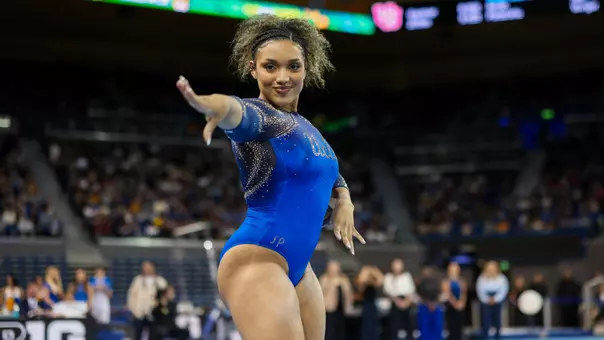
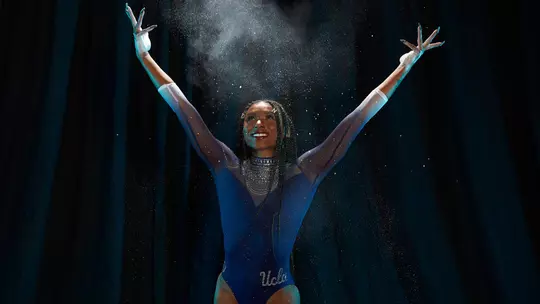
Dennis flashes a pose, hands fashioned into a crown above her head, and she takes a step back to the corner of the mat. A moment ago, her smile could have provided the wattage for a small town; now her face is as serious as a neurosurgeon’s.
Everything is quiet for Nia Dennis in this moment.
Maybe for the last time.
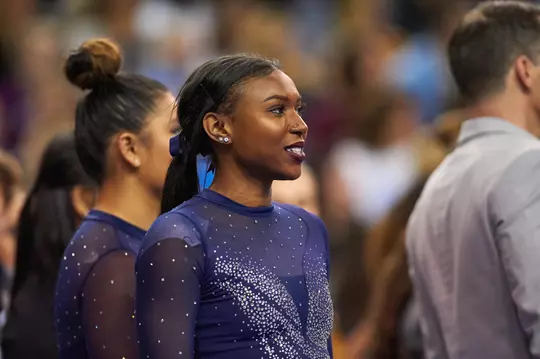
Before she embarks on this last pass — a front handspring, front 1-and-a-half twist into a split jump — she has no idea that this routine will send her into the stratosphere, earning praise from luminaries across the globe. Her floor routine went viral last year, but not like this. Alicia Keys shares this one on Twitter. Missy Elliott — whose music is featured in the performance — shouts her out. Michelle Obama — Michelle Obama!?! — sends the following Tweet: “Now that’s what I call fierce! You’re a star @DennisNia!” That Tweet had almost 98,000 likes one week into February.
Once Dennis lands her final step, she knows.
She’s nailed it. Things might never be the same.
Since then, it’s been a non-stop whirlwind for Dennis. Interview requests have poured in from across the country. She was invited onto The Ellen Show for the second time, this time remotely.
Countless online sites picked up her routine and the kudos she garnered from her new BFF, the former First Lady.
It’s all a little much, really.
“It feels brand new all over again,” she said. “To get this recognition and love is so amazing. It’s so positive. It is a little overwhelming, but it’s a little exciting waking up every day and a new celebrity knows who you are.”
This wasn’t her goal from the start. It was much bigger than this.
Black Excellence is really just a celebration. There are things that don’t get enough attention and light spread on it. No matter what the circumstances are in the world, we always seem to overcome. That’s something I wanted to portray.Nia Dennis
She calls the routine, “The Culture,” a 90-second homage to all that it means to be Black and Proud.
She selected the music that serves as the routine’s backdrop with deliberate precision. She whittled the message down to seven artists — Kendrick Lamar and Beyonce, Missy Elliott and Monica, Soulja Boy, Megan Thee Stallion and Tupac — with dance moves that echoed to generations past. It’s the swaggiest thing ever seen on a blue mat.
“It bubbled up from an emotional feeling and vision,” UCLA gymnastics head coach Chris Waller said. “Nia had a vision of wanting to do something that celebrated Black culture. In the beginning, it wasn’t clear what that would look like. But what it felt like? Nia knew.”
After the shocking death of George Floyd last May sparked a summer of outrage during a time of great international strife, Dennis resolved to let her movements spark a movement. She speaks through the language of gymnastics and dance. Her body is her loudspeaker. What better way to honor all her culture has gone through than through the music and motions that help define that struggle?
“Black Excellence is really just a celebration,” she said. “There are things that don’t get enough attention and light spread on it. No matter what the circumstances are in the world, we always seem to overcome. That’s something I wanted to portray.”
Now that she had the message came the music. The original Spotify list had over 85 songs on it, and, Das said, “the fact we got it down to seven was really tough. I wouldn’t want to do a mashup like this with every routine, but each song had a purpose and an energy.”
“It started with the artists who’ve had an impact on the Black community, or really just on me,” Dennis said, and once she and Das narrowed down the music, they set out to capture the spirit of the culture.
Both Black culture and pop culture.
“A lot of the athletes have a couple signature moves, and with Nia, she always hits the ‘Whoa,’ which is a fun thing for the Den to be in,” Das said. “Those Tik-Tok moments are made for her. If she was doing a classical routine, she wouldn’t add the ‘Nae-Nae’ and the ‘Whoa,’ but because we were so clear on the vibe and the message we wanted to get across, celebrating Black Excellence and Black culture, some of those moves came out organically.”
For Dennis, it’s those little flourishes — those meme-inspired moves — that bring her joy.
“I do my best when I’m having fun,” she said. “When I’m doing my dance, I’m having the most fun, living in the moment. I feel like I’m literally having a party. And seeing (my teammates) do it with me is the biggest dance party.”
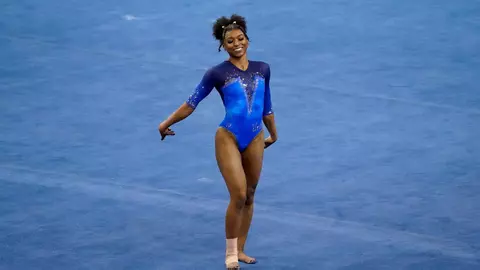
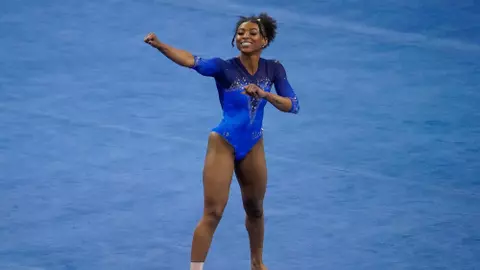
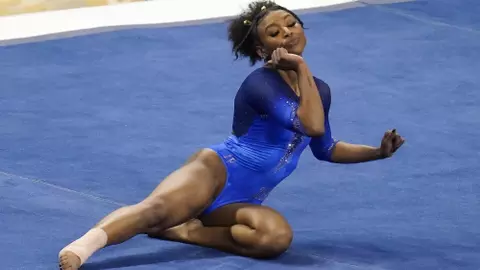
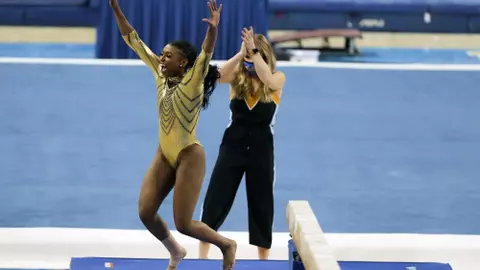
The UCLA floor routines have become the stuff of legends.
Former Bruin head coach Valorie Kondos Field — or, to all, Miss Val — brought a level of pop sensibility to the gymnastics program as an assistant coach early in the 1980s. When she inherited the program herself, rather than adapt her methods to more traditional gymnastics choreography, she dragged the sport into the 21st century.
Now Westwood has become ground zero for high-concept, high-execution floor routines. A UCLA gymnast has gone viral with her routine for six consecutive seasons. At this point, it’s almost expected.
“It’s been going on at UCLA for a long time, but what has developed more recently is that expression through pop culture,” Waller said. “If you look back at the past 30 years of UCLA Gymnastics, you’re going to find 100 iconic routines that are incredibly creative and unique. But what’s happened recently is we haven’t been afraid to embrace pop culture within our floor routines.”
And for every ‘Whip’ and every ‘Nae-Nae’ done on the floor, 20 teammates stand on the sidelines, mimicking her like doppelgangers.
At one point, Dennis faces off with Das, who mirrors her every move. Das was a gymnast herself, walking on at the University of Washington before injuries derailed her career. She ended up a gymnastics coach almost by accident. She is a dancer and choreographer by trade, having performed with Beyonce, P!nk and Usher and toured with Avril Lavigne.
“When I look over and see BJ doing it with me — we have that little moment — once she did it, I felt so much more comfortable,” Dennis said. “Now we share that moment. It’s not just me. There’s a group effort that goes into a routine.”
That may have been the most exciting moment of the video of the routine — at the peak of the performance, every Bruin on the sideline is moving with Dennis.
“It was really important for us to get her (routine) down,” teammate Chae Campbell said. “We really wanted it to feel like we were in it together. There were certain nuances that we took the time to learn.
It’s also a pandemic, and there’s not a crowd, so we have to feed off each other’s energy.”
I’m just so honored. This feels like a dream come true to be acknowledged by Michelle Obama, Missy Elliott. I don’t look it as a responsibility; I look at it as a privilege, an honor. I’m a nobody, but I’m just sharing my joy and passion and trying to inspire.Nia Dennis
Now that she’s entering her 30th minute of fame, Dennis is quick to point out that she doesn’t view this platform as a responsibility, but a privilege.
“I’m just so honored,” she said. “This feels like a dream come true to be acknowledged by Michelle Obama, Missy Elliott. I don’t look it as a responsibility; I look at it as a privilege, an honor. I’m a nobody, but I’m just sharing my joy and passion and trying to inspire.”
In a sport in which women of color are historically underrepresented, Dennis designed her routine with the young version of herself in mind.
“Black representation is so important,” she said. “It’s rare to see Black gymnasts at the elite level. I wanted to be able to represent for the community, and I aspire to inspire. I wanted to inspire a lot of Black gymnasts to know they can do this sport as their most authentic selves.”