University of California, Los Angeles, Athletics
The Trust Factor
October 21, 2019 | General
The following story ran in the Fall 2019 edition of Bruin Blue Magazine.
by Jon Gold
UCLA women's swimming and diving head coach Jordan Wolfrum stepped into her empty new office in the J.D. Morgan Center in early July, ready to leave her mark, ready to make the program — if not the office — her own.
By the middle of the month, still living in a nearby hotel, she barely had time to breathe, much less interior decorate.
There was one item waiting for her, at least.
When she walked into her office for the first time, she found a greeting card left by Cyndi Gallagher, the coach whom she replaced, a legend in their sport.
"To a smart, strong, unstoppable woman," the card reads, "Go forth and run the world."
"That was my permission to go and run with it," Wolfrum said, "and to accept the responsibility that this is."
It is a big one, taking the reins from Gallagher, who spent more than three decades as UCLA head coach, producing more than 90 All-Americans.
For Wolfrum and the two other newest Bruin Olympic sports coaches — gymnastics coach Chris Waller and men's soccer coach Ryan Jorden — the weight of expectation and legacy is on their shoulders.
Right now, weeks or months into the job, there is only one thing more important than the four letters adorning their shirts.
Five letters now rule the day.
T-R-U-S-T.
How do you build it? What are the first steps?
Of the three, Waller had the easiest job. And, perhaps, the hardest.
On the one hand, he is certainly the most familiar with UCLA.

associate head coach at UCLA before succeeding the legendary
Valorie Kondos Field. (Photo: Don Liebig)
A Bruins legend who won either a U.S. or NCAA men's gymnastics title each year from 1989-93, Waller would become one of the great gymnasts in Team USA history, with a berth on the 1992 Olympic team and the 1991 U.S. all-around title. He also spent the last 18 years as an assistant coach at his alma mater, the last seven as associate head coach.
On the other hand, he inherits the two-time defending Pac-12 Champions from Valorie Kondos Field, not only a legendary coach but a formative figure in gymnastics history, worthy of a feting last season that ranks among dignitaries and heads of state.
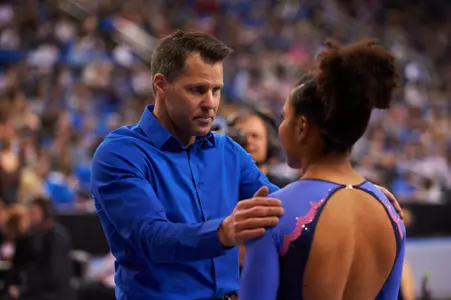
"Day 1 taking over from a coaching legend can be daunting," Waller said. "I've been excited about the possibility of taking over the program for many years, so to finally have it come to fruition was beyond thrilling. But the first thing I needed to do was build trust within the program."
Waller sat down with each current UCLA gymnast, he said, and more than anything, he asked a lot of questions and listened. He wanted "to get a real pulse" of the program.
These athletes know Waller. They trust him, or, at least, the former version of him. But moving into a bigger office is more than just having the ultimate say. Waller had been in charge of so much of the Bruins' fitness and strength, but Miss Val is a stylistic legend, a dance artist and choreographer with the skill and touch to combine that strength with grace.
How will Waller lead? That was an important question for him to answer.
"My leadership style and my coaching style is very different from Val's," he said. "When a new coach comes in, and the old coach's program is so respected, even if they know you, they still want to know, 'what direction is this going?' They think they might know, but there is an important level of comfort you have to build. Ultimately it's about being heard."
Waller used a bit of sage advice from Kondos Field, who'd received it from a trusted source.
"I've been a part of this with Val for so long, but I'm not Miss Val," he said. "As Coach Wooden told Val a long time ago, 'You'd be a very poor John Wooden, but a great Miss Val.' Well, I'd be a terrible Miss Val, but hopefully I can be a great Chris Waller."
If step one is building trust, steps two through roughly 282 unfold over the next week.
Recruiting, meetings, finding a place to live, scheduling, meetings, finding a place to get your morning coffee, meetings. Jorden, who inherited the men's soccer program from Jorge Salcedo at the beginning of May, called the process "onboarding."

history comes to UCLA from the University
of Pacific. (Photo: Don Liebig)
"A lot of what we're doing is compressed work; a lot of things you normally do over a few months happen in a short period of time," Jorden said. "Some of the big things were just getting the pieces out on the table, everything that needed to be addressed. Once those are in place, you can start attacking and prioritizing the necessities, to go after where you think you can make a difference."
Jorden, the 11th coach in UCLA men's soccer history, comes to Westwood from Stockton, California, where he restarted a dormant University of Pacific program and helped lead the Tigers to the second round of the NCAA tournament in each of the last three seasons. Before Jorden, Pacific hadn't fielded a varsity men's soccer team in 28 years. Three years later, he was West Coast Conference Coach of the Year.
So he knows how to accomplish things in a hurry, and with a few months under his belt and a month to work with the team before the summer, Jorden is starting to settle in.
"I feel real comfortable on campus, with the guys on the team," he said. "We had four weeks to spend time with the players and start to paint the picture we want them to see. Players are sometimes excited by change, and by new opportunity, to start to develop and work on a new project. It's fun to partner with them in that and give leadership to that project, to find out what their qualities are, what is their part of the puzzle."
Jorden might not be ready to put together the puzzle quite yet, but the pieces are on the table. Some of the corners are coming together, if not the corner kicks. Jorden has watched ample film and has some familiarity with the Bruins' strengths, and he said the next step is building "a road map in your mind, how you go about assembling what you want to be a successful group."
That, Jorden said, is the best part of the job.
"Team culture is the fun part to build," he said. "You get to take a collection of individuals who all have a common goal and different personalities, and put it together to achieve a common aim. When you're working on developing that culture, the relationship becomes an important component. The honesty and sincerity is critical. As you start to implement the ideas you have, the student-athletes are very sharp in understanding authenticity. That's something they crave and want to be part of."
Wolfrum did not arrive in Westwood until July 8, but she'd already been on the job for a week.
"The first thing I did, pretty much as soon as it was announced, was get in touch with all of the current athletes and incoming athletes," Wolfrum said. "I went through every single person I had contact info for, and introduced myself and shared my enthusiasm."
From one conversation it became evident: There is a lot of enthusiasm.
And there should be. Wolfrum, 32, is coming off a five-year stint as an assistant coach at Ohio State, with just one year of head coaching experience, at Div. III College of St. Benedict in St. Joseph's, Minnesota, in 2012. She sounds a bit surprised that she got the gig in the first place, especially considering it is her dream gig.
"It's been kind of my stated dream job for a long time," she said. "I didn't think it would come open this quickly, and I didn't know I'd be the one to get the shot. I got a text that Cyndi was retiring and at that moment, I said, "Well, OK, you always said you were gonna do it. You've gotta go for it."
During the interview process, UCLA athletic director Dan Guerrero said Wolfrum "impressed us with her vision for where she believes she can take the program and her enthusiasm about the opportunity to join the Bruin Family. I know the future of the program is bright with Jordan at the helm."

Jordan Wolfram helped Ohio State to
top-25 finishes in four of her five seasons
in Columbus. (Photo: Jesus Ramirez)
He also added that Wolfrum — who helped lead the Buckeyes to top-25 finishes in four of her five seasons, with third-place finishes in the competitive Big Ten Championships the last two seasons — "comes from an athletic department with an excellent, winning culture," and added "she's no stranger to high athletic expectations."
"This is a big (job)," Wolfrum said. "I don't want to say I have no idea why they hired me — I feel like I put my best foot forward — but I also get the sense they took a chance on me, that they trusted my word when I said I was a culture-focused, process-focused coach, and that I am willing to learn and stick to it and use the resources around here. I do however feel particularly honored and very proud — but also feel the pressure. I was an assistant coach and this is a big step, and they are trusting the vision I have for the program and my character to back it up. I don't take that lightly."
That is one reason that, as of mid-July, she was putting in long hours and was still living in "a very lovely hotel." She has started to sniff out some of the local creature comforts. There is a Starbucks "a mile from my very lovely hotel," and get this: She's able to get there without Waze. She even discovered the local Target, just a quick walk from her office.
"It's been a big week," she said.
While she said it was heartbreaking to arrive on campus when most of her athletes are gone for summer, she added that it may be a blessing in disguise.
"It's letting me get my feet on the ground and get things sort of settled," she said. "When we all are on campus, I feel confident I'll be able to be in a place to hit the ground running. I'm excited about that. But it doesn't make this time any less crunchy. This isn't the glamorous part of coaching. This is the building blocks of what we have to do to take good care of somebody else's kid."
More so than even the responsibility to win, especially on an ultra-competitive campus such as UCLA, Wolfrum values that role.
"The trust piece is big, and it's hard to start when you're not in front of them," she said. "It kind of broke my heart I wouldn't be immediately in front of the team. Reaching out, especially individually, was an important step to calm nerves. As a coach, that makes you feel normal, like you're doing your job. The part that anchors me, the part I love about coaching, is not purchase orders and housing assignments. It's the human interaction, it's the relationships."
In a word, it is trust, and for these new UCLA coaches, that is more than just a five-letter word.